
I spend most of my weeks sitting across from founders and CEOs — in Focus Days, Quarterly sessions, and Annual Planning meetings. And over the last 18 months, something has shifted. The conversation isn’t just about Rocks and Scorecards anymore. It’s about how to run a better business with AI in the room.
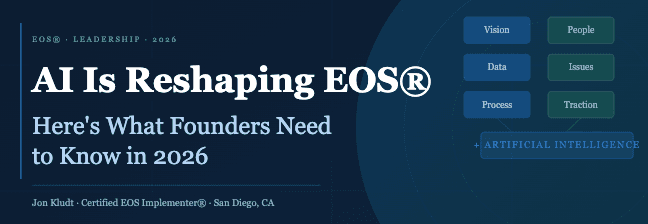
Let me be direct: EOS is not broken. The Six Key Components — Vision, People, Data, Issues, Process, and Traction — are as relevant in 2026 as they were when Gino Wickman first built the model. What’s changed is the speed at which you can execute on them and the depth of insight available at every level.
What’s changed is the amplifier. AI is now a legitimate accelerator inside EOS — if you know where to plug it in and where to leave it alone.
What is EOS and why does it matter in 2026?
The Entrepreneurial Operating System® (EOS) is a complete business framework built on six core components: Vision, People, Data, Issues, Process, and Traction. It gives founders and leadership teams a shared language and a consistent rhythm for running their business.
More than 200,000 companies worldwide now run on EOS. In my experience as a Certified EOS Implementer® based in San Diego, the companies that get the most from EOS are those with 10–250 employees — large enough to need structure, small enough to move fast.
That context matters because AI doesn’t change the foundation. It changes the speed and quality of what you can build on top of it.
Where AI is genuinely transforming EOS — component by component
The Data Component: your Scorecard just got smarter
The Data Component is the first place AI is making a real, measurable difference for EOS companies. Most leadership teams review their Scorecard in the Level 10 Meeting and discuss what’s off track. But historically, the analysis has been manual, reactive, and limited to whatever the team notices in the moment.
AI changes that. Tools layered on top of your existing data infrastructure can now surface anomalies, flag trends before they become problems, and generate automated commentary on what the numbers actually mean week over week.
The practical implication: your team shows up to the L10 with actual insight, not just raw numbers. The meeting gets sharper, faster, and more focused on solving real issues.
The Issues Component: better IDS starts before the meeting
IDS — Identify, Discuss, Solve — is one of the highest-leverage tools in EOS. It’s also one of the most commonly done poorly. Teams rush through Identify, jump to solutions, and end up re-litigating the same Issues quarter after quarter.
AI is changing the pre-work. Founders I work with are now using AI tools to draft Issues before the L10 — writing up root cause hypotheses, summarizing background data, and proposing potential solutions before the meeting even starts.
The key insight: AI doesn’t replace the IDS process — it compresses the setup cost so your team spends more time on the Discuss and Solve steps, which is where the real decisions get made.
The Process Component: documentation is no longer the bottleneck
One of the most common reasons EOS companies stall on the Process Component is simple: documenting the Core Processes is tedious. Leadership teams know their processes intuitively, but translating that institutional knowledge into written, followed, and managed documentation feels like bureaucratic work.
AI has essentially eliminated that excuse. Founders are now using AI to transcribe walkthroughs, draft process documentation from meeting notes, and even generate training materials from existing SOPs. What used to take weeks now takes hours.
Where AI does NOT belong in EOS — and why this matters
This is the part I feel strongly about, and frankly the part that most articles written about AI and EOS get wrong.
The People Component — the most important and most difficult component of EOS — is not an AI problem. It’s a human problem.
Figuring out whether someone is in the Right Seat. Having the honest conversation about whether a longtime employee still fits the culture. Navigating the tension between personal loyalty and organizational health. These are human-judgment calls that require empathy, courage, and context that no language model can replicate.
The same goes for the Visionary/Integrator dynamic. I’ve worked with enough founding teams to know that the tension between a Visionary and an Integrator is a feature, not a bug — and it requires a human facilitator to channel that tension productively.
A word of caution: The biggest risk I see for EOS companies in 2026 is not moving too slowly on AI adoption. It’s moving too fast without understanding what AI is actually good at inside the framework. Using AI to surface better data is a force multiplier. Using AI to avoid hard People conversations is a liability.
What smart founders running on EOS are doing right now
Based on what I’m seeing across my client base, here’s where the most operationally mature companies are focusing their AI efforts:
- Automated Scorecard commentary. Using AI to generate a plain-English narrative of Scorecard trends before each L10, so the team spends less time interpreting numbers and more time deciding what to do about them.
- AI-assisted Rock setting. Using AI as a thought partner during Quarterly Planning — not to set Rocks, but to stress-test them. “Is this Rock measurable? Is this achievable in 90 days? Does this align with the 1-Year Plan?”
- Process documentation sprints. Dedicating one focused session per quarter to using AI to document one Core Process end-to-end. Within a year, the entire Documented Process becomes a living asset instead of a shelf project.
- Pre-framing Issues before the L10. Asking team members to use AI to write up their Issues with context, root cause analysis, and proposed solutions before the meeting — so IDS starts at a higher level.
- Meeting pulse analysis. Using AI to review Level 10 Meeting notes over time, identifying recurring Issues that aren’t getting solved, stale Rocks, and patterns the team might be missing.
The bottom line for founders and CEOs
EOS gives you the operating system. AI gives you a faster processor. But a faster processor running bad software still crashes.
The companies that will lead in 2026 and beyond are the ones that pair disciplined execution with intelligent automation — not the ones chasing every new tool while their operating rhythm falls apart.
If you’re running on EOS and wondering how to bring AI into your operating rhythm — or if you’re not on EOS yet and wondering whether it’s still relevant — I’d love to have that conversation. It starts with a free 90-minute session where we look at where you are, where you want to go, and what’s actually in the way.